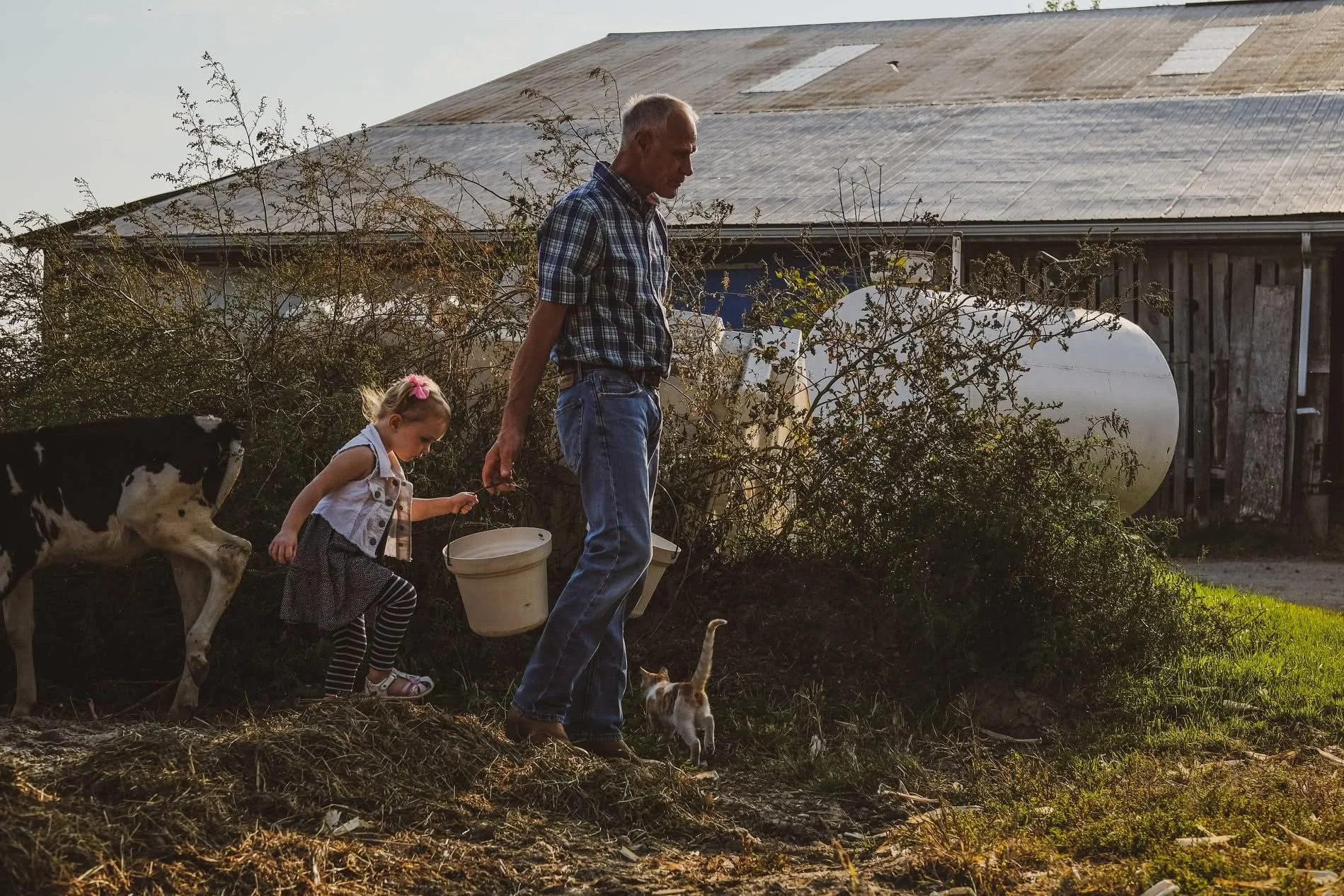
This is not Just About Milk
Donald Trump keeps saying that Canada charges American dairy farmers tariffs of 250 or 300 per cent.
It is an extraordinary number. It is also an extraordinarily misleading way to explain how Canadian dairy works.
Canada does not charge a 300 per cent tariff on every carton of American milk or block of American cheese that crosses the border. American dairy products already enter Canada at low or zero tariffs within quantities negotiated under our trade agreements. The enormous rates Trump repeats apply only after those quotas have been exceeded. American dairy exports have not come close to reaching them.
But Trump leaves that part out.
Instead, he takes one frightening number, removes the system surrounding it and uses it to portray Canadian farmers as cheats and Canadian food protections as an attack on the United States.
They are neither.
Milk is not some obscure product most Canadians never think about. It is in our refrigerators, our children’s lunches, our coffee, our cooking and much of the food we buy. Cheese, yogurt, butter and cream are part of the weekly grocery bill in households across the country.
When my children were growing up, I bought three bags of milk every week. Three bags, week after week, for years. Changes to the price, quality or availability of milk would not have been an abstract matter of international trade. They would have reached directly into my kitchen and my family budget.
That is why this conversation matters.
Canada has a supply-management system for dairy, poultry and eggs. It regulates production, stabilizes prices for farmers and controls the quantity of foreign products entering the Canadian market. It is not a perfect system. It can increase prices for consumers, and the cost of acquiring production quota can make it difficult for new farmers to enter the industry.
Those are legitimate Canadian conversations to have.
But there is a profound difference between Canadians examining and improving their own agricultural system and Canada being forced to dismantle it under threat from another country.
Canada has already made concessions. Under CUSMA, the agreement negotiated during Trump’s first administration, American producers received additional access to the Canadian dairy market. Canada has also opened portions of its market through agreements with Europe and trans-Pacific countries. By 2031, imports entering under our various trade agreements are expected to represent a significant portion of the Canadian dairy market.
The United States is not locked out.
What the Americans appear to want now is considerably more. They want greater access to the Canadian market, changes to the way Canada administers its import quotas and fewer protections for Canadian producers. Trump claimed during the recent negotiations that tariffs for American farmers would be brought down to zero, while Canadian officials continued to insist that supply management would remain intact.
Both of those things could not be entirely true.
And this conversation is happening at a particularly troubling moment.
Over the past year, the Trump administration has made significant cuts to the American agencies responsible for food inspection, laboratory testing and outbreak response. Food-safety experts have warned that staffing losses at the Food and Drug Administration and the United States Department of Agriculture mean fewer inspectors, less institutional knowledge and a weakened capacity to identify problems before contaminated food reaches the public.
Foreign food-facility inspections by the FDA have also fallen sharply.
At the same time, the United States is experiencing a disturbing series of foodborne illnesses and recalls involving eggs, sprouts, peppers, lettuce, frozen berries, powdered milk, cheese and other products.
A salmonella outbreak connected to jalapeño peppers has affected hundreds of people across more than 30 states. Eggs have been linked to another large outbreak and a recall involving millions of eggs. Raw dairy products have been connected to E. coli illnesses, including cases involving young children.
But the most startling numbers involve cyclospora, a parasite that causes severe and sometimes prolonged diarrhea. Since May 1, 2026, the United States Centers for Disease Control and Prevention has recorded more than 15,000 laboratory-confirmed domestically acquired cases. During approximately the same period the year before, it recorded fewer than 1,200.
Not all of these outbreaks began on American farms. Some involved imported produce. Nor can we responsibly claim that every outbreak was directly caused by regulatory cuts. Foodborne illnesses occurred long before Trump returned to office.
But it is reasonable to ask what happens when the agencies responsible for monitoring a vast food system lose staff, inspections decline and serious outbreaks are already proliferating.
This is not the moment for Canada to relinquish its ability to decide what enters our food supply.
Canada and the United States both regulate milk, but our systems are not identical. Canada has not approved the artificial growth hormone rBST for use in dairy cattle. Canadian milk is tested for antibiotic residues, and commercial milk must be pasteurized before it can be sold. American milk imported into Canada must meet Canadian requirements, but that protection remains meaningful only as long as Canada retains the authority to establish and enforce those requirements.
This is not an argument that every American dairy product is dangerous. It is not.
It is an argument that Canada has the right to decide which production practices and safety standards it will accept. Market access should not become a back door through which another country pressures us to weaken those decisions.
The larger agricultural demands reportedly went beyond milk. The United States has also objected to Canadian protections for poultry and eggs, our seed-registration system, some rules governing fruit and vegetable imports and other policies it describes as barriers to American trade.
But a regulation is not illegitimate simply because it prevents an American corporation from selling something here.
Some barriers protect farmers. Some protect consumers. Some preserve domestic production so that Canada does not become entirely dependent on another country for essential goods. Some ensure that seeds, animals and food products meet standards Canadians have chosen for themselves.
Those distinctions matter.
They matter particularly in Québec, where dairy farming and cheesemaking are not simply economic sectors. They are part of the landscape, the history and the living culture of rural communities. When we speak abstractly about opening the Canadian dairy market, we are also speaking about the farms that shape those communities, the small processors and cheesemakers who give regions their character, and the families who have built their lives around producing food here.
Trump presents Canada’s agricultural protections as though they are evidence of hostility toward American farmers.
They are not.
American farmers deserve stability too. Many of their difficulties come from overproduction, consolidation, rising costs, volatile commodity prices and domestic policies over which Canada has no control. Dismantling the Canadian system would give large American producers access to another market. It would not repair everything that is broken in American agriculture.
It could, however, seriously damage ours.
This is why the details of the rejected trade agreement matter. From what has been reported, Canada was being asked to make lasting changes to its laws and policies while the American commitments offered far less certainty. We could open our market, weaken our protections and disrupt Canadian farms, only for the United States to restore the tariffs later because it had found another Canadian policy it considered unfair.
That is not a reliable trade agreement.
It is an ultimatum.
Canada is allowed to protect its farmers. We are allowed to maintain our food standards. We are allowed to decide how much foreign dairy enters our market and under what conditions. We are allowed to support rural communities and preserve some capacity to feed ourselves.
We can debate supply management. We can reform it. We can ask whether it is serving farmers, consumers and new agricultural producers as well as it should.
But that debate belongs to us.
We do not have to reorganize our food system around the commercial interests of the United States simply because it is larger than we are. We do not have to exchange permanent Canadian concessions for temporary relief from an American administration that has repeatedly demonstrated how quickly its trade commitments can change.
This is not just about milk.
It is about whether Canada continues to control its farms, its food standards and its future.
And we are allowed to protect all three.