The Fire and the Network - what Technology Cannot Decide for Us
By midnight, the wood was gone. So was the wine.
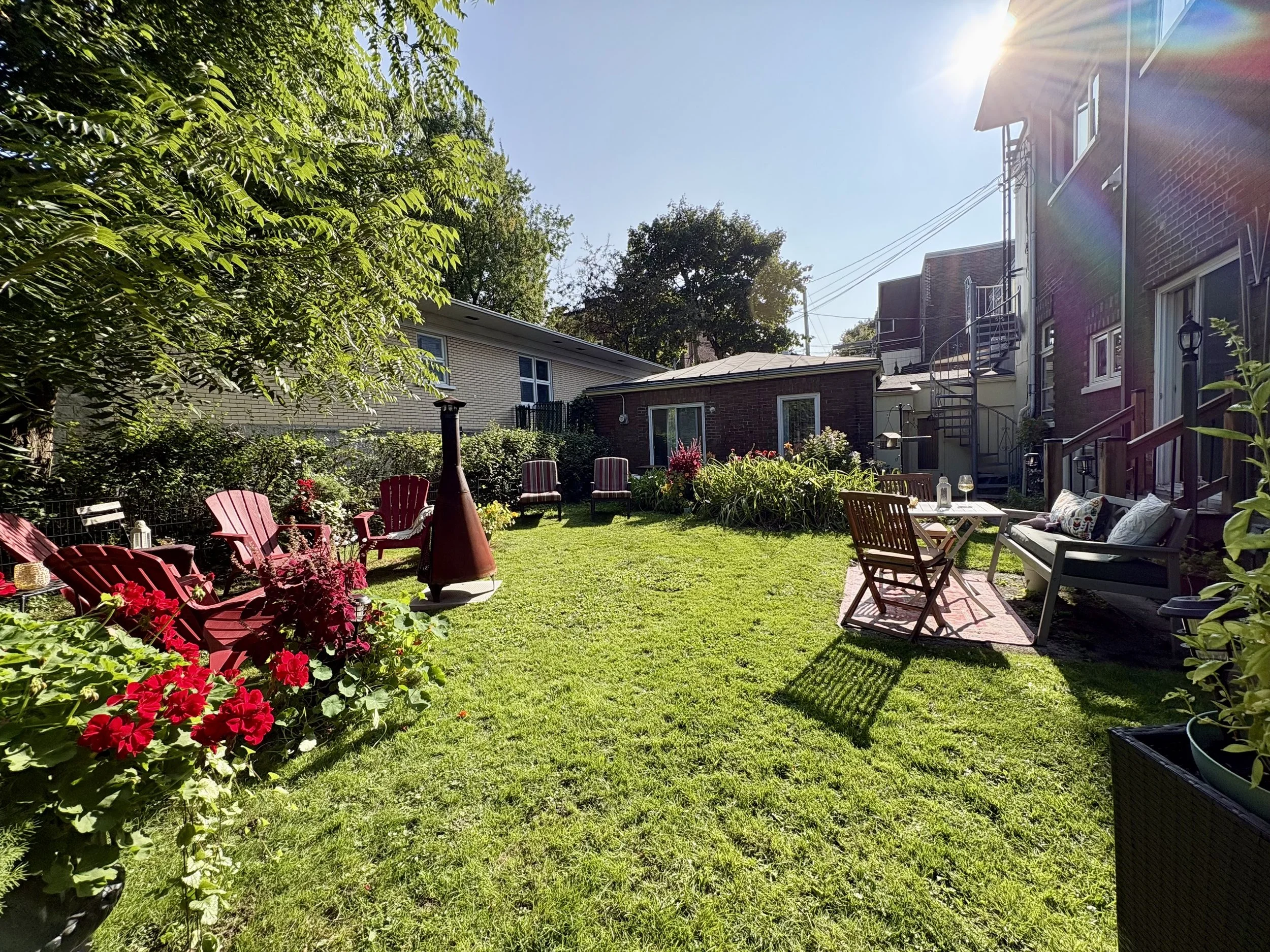
What was meant to be a small Friday garden cinq à sept had stretched from six until twelve. We had spent six hours gathered around a technology older than civilization.
The fire was not decoration. It made the garden habitable after dark. When it weakened, someone added another piece of wood. When the last piece burned down, the evening came naturally to its end.
Above us, twinkle lights shone against the trees. Music travelled from the internet through a small speaker on the table. When I was young, someone would have had to go inside and put on a record. Now almost every song ever recorded could follow us into the garden.
The technology was everywhere, but it remained in its proper place. It served the gathering.
Birds came in long swoops to eat before dark. Someone asked where they went at night. Where did the squirrels sleep? Where were the raccoons when we could not see them?
Beyond our little circle of firelight, an entire living world continued without our supervision. The birds knew where to go. The trees held more life than we could see.
Perhaps I noticed the beauty so sharply because I have not always felt safe where I lived. There was another apartment, not so long ago, where my body never entirely settled. The door did not feel like a boundary the world would respect.
Even within the same city, safety can change from one street to the next.
Quebec City is extraordinarily beautiful, but its beauty is not evenly distributed. Where I live now, there are trees everywhere. They hold the birds, soften the streets, and make room for people to linger. Down the hill in Saint-Roch, there are far fewer trees and far less green. It can feel like a different universe.
A city reveals what it values through what it gives people freely: shade, quiet, beauty, places to gather, and the feeling that they belong there.
Safety is like that too. It is quiet. We notice it most clearly once we have lived without it. For many Canadians, it still means sitting in a garden without watching the street. It means trusting that a home is private and a door is a boundary. It means allowing the body to forget danger for a few hours.
This safety is imperfect and uneven. Indigenous people, racialized communities, migrants, and people living in poverty have not experienced it equally. Still, it is part of what we believe Canada can be. We do not want to wake one morning and discover that the things we treated as ordinary were protections we should have been defending.
Only a few days ago, Donald Trump posted a map in which Canada’s border disappeared beneath the American flag. A map is not an invasion plan. But when it is posted by the president of the country next door, after repeated talk of annexation, it is not nothing.
This week, Prime Minister Mark Carney and Ukrainian President Volodymyr Zelenskyy announced a major expansion of Canada’s drone capacity. Initial contracts worth up to $50 million will increase the number of drones deployed by the Canadian Armed Forces tenfold. The larger plan is to give Canadian industry the capacity to produce millions of them within two years.
The first contracts are for intelligence, surveillance and reconnaissance drones, along with uncrewed ground vehicles. But the Defence Drone Initiative goes further. Its published scope includes drone munitions, explosive payloads, and deep precision-strike systems.
So yes, some of these machines may eventually be able to kill.
Canada cannot pretend the world is safer than it is. Ukraine is defending itself against a much larger force. The American president has just published a map in which our country no longer exists. Remaining unprepared is also a choice, and perhaps no longer a responsible one.
Still, the machinery we build for protection today will remain for the governments of tomorrow.
A drone can watch an Arctic coastline. It can also watch a crowd. With the right cameras, sensors, and software, it can follow a person or vehicle across a city. It can find someone who is lost or keep a record of someone who has done nothing wrong. It can defend a population or teach a government to observe its own people without blinking.
The machine does not know the difference.
We may need these machines because governments can change. We must be wary of them for exactly the same reason.
This is the crossroads. Our tools are becoming more powerful, more autonomous, and more deeply embedded in ordinary life. The same network can carry music into a garden or targeting information across a battlefield. The same camera can preserve a human face or reduce a person to coordinates on a screen.
Technology expands the reach of our choices. It does not make us wiser about what to choose.
Yesterday, a student arrived in my art class carrying a copy of 1984.
“Miss,” he said, “this was written in 1949. This is real life now.”
He was right about the year. George Orwell published the novel more than seventy-five years ago. I have taught English for most of my life. I have started 1984 and put it down. Perhaps it frightened me.
He did not explain which part felt real. He did not need to.
Perhaps this is what books do. They wait quietly on our shelves until the world catches up with them.
Surveillance is not the whole human story.
We have been taught a narrow story about survival. The strongest win. The fittest endure. But human beings did not survive by strength alone. We survived because we shared food, tended fires, protected children, carried the injured, and made room for those who could not outrun danger. Sometimes the choice that looks least efficient is the one that preserves the world worth living in.
Yesterday evening in the garden, nobody remained simply a guest. People carried food, poured drinks, used the kitchen, and cleared things away. Without discussion, the gathering became collaborative. What began as an invitation became a small community.
The garden was not magical because danger had disappeared from the world. It was magical because, for one evening, we made a place of warmth within it. We were safe enough to stop calculating risk. Safe enough to tell stories. Safe enough to wonder where the birds went after dark.
By midnight, the fire had lowered itself into embers. Somewhere beyond the twinkle lights, the birds had found their hidden places for the night.
Technology may determine how far our power can reach. It cannot determine what we reach for.
That choice is still ours.
SOURCES
Prime Minister of Canada: Canada and Ukraine to scale up drone production
https://www.pm.gc.ca/en/news/news-releases/2026/09/10/canada-and-ukraine-scale-drone-production-build-canadas-defence
National Defence: Government of Canada launches Defence Drone Initiative
https://www.canada.ca/en/department-national-defence/news/2026/07/government-of-canada-launches-defence-drone-initiative-to-strengthen-canadas-sovereign-defence-capabilities.html
Office of the Privacy Commissioner of Canada: Drones in Canada
https://www.priv.gc.ca/en/opc-actions-and-decisions/research/explore-privacy-research/2013/drones_201303/
Associated Press: Trump’s map-making on social media stirs controversy in North Atlantic
https://apnews.com/article/af9b37f1cf7bbdcbd891a23ac1a018a0